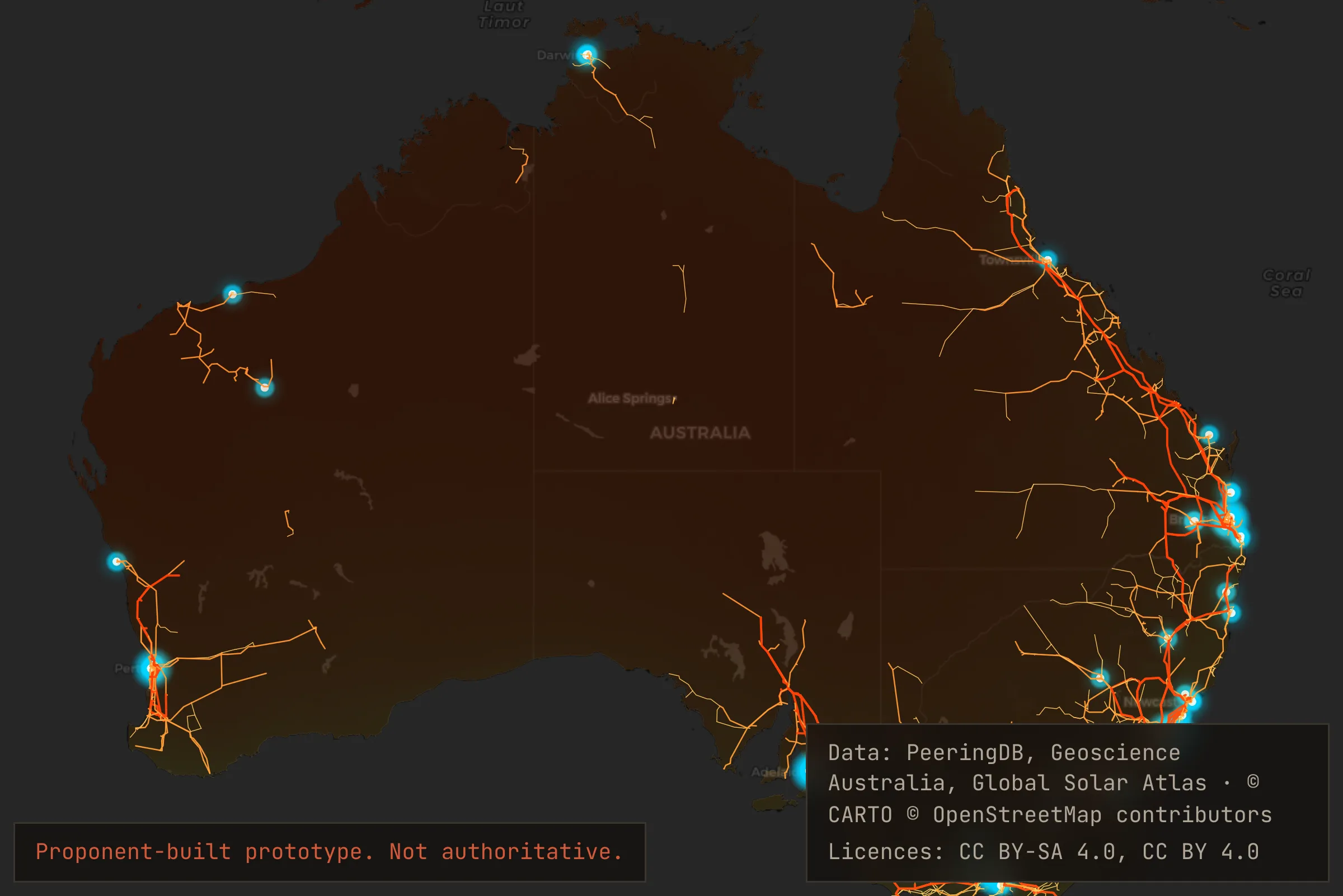
Inland Australia has a real cost advantage
The Trans Australian Solar Corridor is a concept-stage proposal for a staged inland system: solar generation, storage, and co-located compute, processing, and water. It exists to test whether that cost advantage is large enough — and the workload fit narrow enough — to justify building.
The One Thing to Take Away

Three Supports
Cost. Inland solar LCOE sits at A$40–55/MWh. Firmed 24×7 to 99% availability on-site: A$80–120/MWh. Transmitted to coastal load: A$110–180/MWh — uneconomic. The corridor thesis rests on the middle number.
Fit. The workloads that value cheap power more than low latency are a specific set: AI training, batch compute, sovereign cold storage, HPC, and energy-intensive processing. The site is explicit about what does not fit.
The corridor is staged: five gates, each with a threshold, each contingent on the previous clearing.
Sequence. Gate 0 is consent from Traditional Owners on whose Country the corridor would sit. Gate 1 is one node that clears its own economics. The site does not defend anything beyond Gate 2 as bankable.
What the Site Is
- A concept proposal, not a project
- Deliberately anonymous at concept stage
- A working iteration — content will change
- Not validated by any of the parties whose involvement it would require
See About.